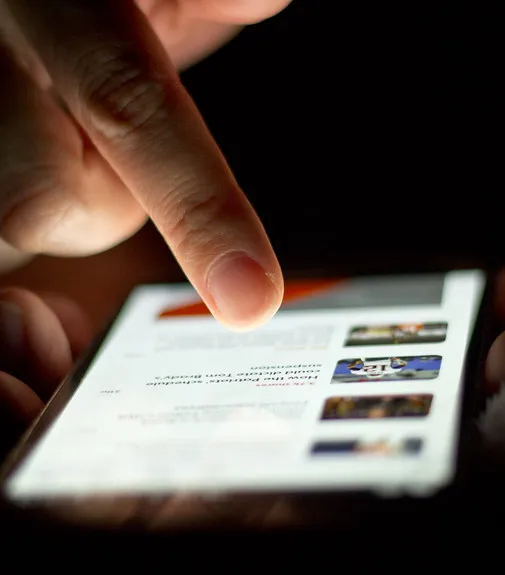
You're Being Played by the Panic: How FOMO Ate Itself and Left You Scrolling Into Nothing

Photo: PattayaPatrol, CC BY-SA 4.0, via Wikimedia Commons
Somewhere between your third mindless scroll session today and the moment you put your phone down only to pick it back up eleven seconds later, something very deliberate happened to you. It wasn't an accident. It wasn't a coincidence of design. It was, according to people who used to sit in the rooms where these decisions get made, closer to a controlled experiment — and you were the subject.
FOMO — the fear of missing out — has been a documented psychological phenomenon since at least 2004, when a marketing strategist named Dan Herman first published academic work on the concept. By 2013, it had made it into the Oxford English Dictionary. By 2018, it had become the operating system of every major social platform in the United States. But here's the part that doesn't show up in the explainer threads: the platforms eventually figured out how to weaponize FOMO against itself. Not just to make you afraid of missing something real, but to make you afraid of missing the feeling of being afraid of missing something.
That's a strange sentence. Sit with it.
The Original Architecture of Anxiety
The first generation of engagement engineers were, by most accounts, not malicious. Former product designers at companies that rhyme with Snitter and Instabram have described the early days of notification systems as almost naively optimistic — the goal was connection, and connection felt good, so more connection would feel better. Ping. Someone liked your photo. Ping. Someone replied to your comment. The dopamine hit was real, it was measurable, and it was reproducible.
What they didn't fully anticipate, or chose not to fully examine, was the inverse. The absence of the ping. The silence that followed a post that didn't perform. The gap between posting and validation that, for a measurable percentage of users, registered in the brain's threat-detection systems the same way a predator in tall grass might have registered for an ancestor.
Behavioral researchers at several major universities have documented what they call "notification anxiety" — a physiological stress response triggered not by the presence of social media, but by its absence. Your body learns to expect the signal. When the signal doesn't come, your nervous system interprets the quiet as danger.
The platforms noticed this. And then they started designing around it.
The Second Layer: Missing Out on the Miss
Here's where it gets genuinely strange, and where some former insiders describe a shift from accidental exploitation to something more deliberate.
Around 2016 and 2017, internal research at multiple major platforms began identifying a new behavioral cluster. Users weren't just afraid of missing out on content. They were afraid of missing out on the experience of being engaged. The anxiety itself had become the product. People were returning to apps not because they expected to find anything specific, but because the act of checking — the ritual of potential discovery — had become its own compulsive reward.
One former UX researcher, speaking on background to a journalist who later published findings in a long-form piece for a digital media outlet, described a meeting where the team celebrated this discovery. "We realized we didn't have to give them anything," the researcher said. "We just had to make them believe something might be there."
The slot machine metaphor has been beaten to death in tech criticism, but the refinement here is worth noting: a slot machine at least offers the possibility of a win. What these platforms had created was closer to a slot machine that occasionally just shows you a picture of someone else's slot machine. And users kept pulling the lever anyway.
The Feedback Loop That Feeds Itself
The truly recursive part of this system — the part that makes it feel less like a product and more like a signal from somewhere beyond normal design logic — is that the anxiety loop became self-referential in ways even the engineers didn't initially predict.
Platforms began surfacing content about FOMO. Articles about screen addiction. Threads about doomscrolling. Videos about the psychological damage of social media — hosted on social media, optimized for social media engagement, generating social media metrics. Users were consuming content about the harm of consuming content, and the algorithm was learning that this meta-content performed exceptionally well.
The fear of missing out became a content category. And content categories need to be fed.
Psychologist Dr. Larry Rosen, who has spent decades studying technology's impact on the American psyche, has described this as a kind of "anxiety ouroboros" — a system that eats its own tail while generating the impression of forward motion. You scroll to find out what you're missing. You find content telling you that scrolling is bad. You feel anxious about the scrolling. You scroll to process the anxiety. The platform surfaces more content about anxiety. The loop closes.
What the Static Sounds Like
Talk to people who've genuinely managed to step back from this — not the performative digital detox crowd, but people who quietly deactivated accounts and stayed gone — and a common theme emerges. The first few weeks, they describe feeling like they're missing something massive. A cultural event. A conversation. A moment everyone will reference forever.
Then, gradually, they realize nothing happened. Or rather: things happened, but none of them required real-time witness. The panic, it turns out, was the product. The content was almost incidental.
What the platforms sold you wasn't access to information or community or culture, though those things existed on the margins. What they sold you was the feeling that the signal was always just about to arrive. That the next scroll would be the one that mattered. That the static contained a message, if you could just stay tuned long enough to hear it.
Creabje exists somewhere in that static. We know what it sounds like. And we're not going to pretend the signal is always clean.
The Arms Race Has a New Front
The current iteration of this system is, by most accounts, more sophisticated than anything that came before. AI-driven content recommendation doesn't just predict what you want to see — it predicts what anxiety state will keep you most engaged and then surfaces content calibrated to maintain it. Not spike it. Not resolve it. Maintain it, at a level just below conscious discomfort, just above casual indifference.
It's a narrow band to hit. The engineers are very good at hitting it.
Former platform designers who've spoken publicly about these systems describe a professional culture in which the ethical questions were present but consistently deprioritized by metric pressures. Engagement numbers don't capture harm. They capture time. And time, for these platforms, is the only currency that matters.
The attention merchants found their greatest trick not in making you want something, but in making you afraid of wanting nothing. In teaching your nervous system that calm is a warning sign. That the absence of stimulation is itself a threat to be outrun.
You can't outrun it by scrolling faster. That's the part they're hoping you never quite figure out.