Hello? Is Anyone Out There? The Weirdest Things Space Has Ever Sent Our Way
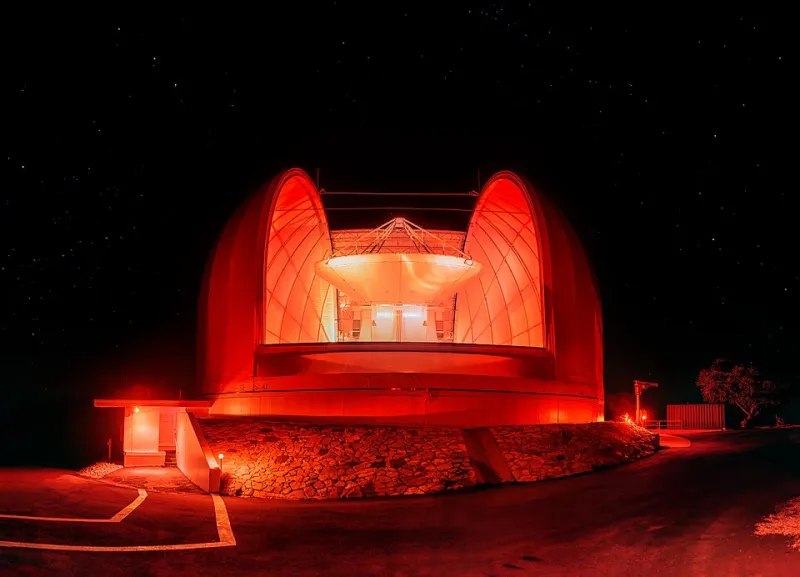
Photo: KPNO/NOIRLab/NSF/AURA/P. Horálek, CC BY 4.0, via Wikimedia Commons
Most of the universe is silence. Or at least, most of it broadcasts in frequencies we don't bother to listen to. But every so often, something arrives through our radio telescopes that doesn't fit neatly into any known category — something that sits right at the edge of explanation, close enough to understand that it's real, far enough from familiar that no one can quite agree on what it means.
This isn't a list of alien conspiracies. It's something more interesting: a collection of documented, peer-reviewed, genuinely baffling phenomena that have occupied serious researchers for decades. The truth, as it turns out, is weirder than most fiction.
The Wow! Signal (1977)
Let's start with the one that started everything. On August 15, 1977, astronomer Jerry Ehman was reviewing data from the Big Ear radio telescope at Ohio State University when he noticed something extraordinary. A 72-second burst of radio energy had been recorded, bearing the hallmarks that SETI researchers had theorized an extraterrestrial transmission might carry — specifically, it arrived at the 1420 MHz hydrogen line frequency, which scientists had long suggested would be the logical frequency for any civilization trying to announce itself across the cosmos.
Ehman circled the data printout and wrote "Wow!" in the margin. The name stuck.
Decades of follow-up observation have never reproduced the signal. It has never been detected again. Proposed explanations have ranged from a passing comet (a hypothesis most researchers consider unconvincing) to terrestrial radio interference to, yes, the big one that no serious scientist will commit to on record but that everyone privately acknowledges is on the table. The Wow! signal remains the single most compelling piece of potential evidence in the SETI archive, and its stubbornness about yielding an explanation is a large part of why it still captures imaginations nearly fifty years later.
Fast Radio Bursts: The Universe's Unexplained Percussion
For decades, the Wow! signal was a lonely anomaly. Then, in the 2000s, researchers started cataloging a new phenomenon: Fast Radio Bursts, or FRBs. These are extraordinarily brief — milliseconds long — but staggeringly powerful pulses of radio energy that appear to originate from outside our galaxy.
The first confirmed FRB was identified in archival data from the Parkes Observatory in Australia in 2007. Since then, hundreds have been cataloged. Most appear once and never repeat. Some, however, repeat — and that repeatability is what makes them particularly interesting.
FRB 121102, nicknamed the "Repeater," was the first confirmed repeating Fast Radio Burst. It's been traced to a dwarf galaxy about 3 billion light-years away, and it pulses with enough regularity that researchers have been able to study its behavior over time. The current leading explanations involve magnetars — incredibly dense, magnetically intense neutron stars — but even the scientists who favor that explanation acknowledge it doesn't fully account for all observed FRB characteristics. The universe, as usual, is not making this easy.
The Alien Megastructure Star (Tabby's Star)
In 2015, a paper by astronomer Tabetha Boyajian and her colleagues described something that genuinely broke the internet for a news cycle: a star, KIC 8462852, that was dimming in ways that no known natural phenomenon could cleanly explain. Standard star dimming — caused by orbiting planets passing in front — produces regular, predictable dips. Tabby's Star was doing something irregular, asymmetrical, and frankly bizarre.
The "alien megastructure" hypothesis — specifically, that an advanced civilization might be constructing a Dyson sphere or similar structure around the star — was floated not by fringe theorists but by a legitimate SETI researcher, Jason Wright at Penn State, who noted that the dimming patterns were "consistent with" such a structure. He was careful about his language. The media was not.
Subsequent research has largely settled on a more mundane explanation: swarms of dust and debris. But the episode is instructive. For a few months in 2015, the scientific community seriously and publicly entertained the possibility that we might be looking at evidence of an alien civilization. That's not nothing.
The Cosmic Microwave Background Cold Spot
The Cosmic Microwave Background is essentially the afterglow of the Big Bang — the faint radiation that permeates the entire universe and has been mapped in extraordinary detail by satellites like WMAP and Planck. It's remarkably uniform. Except for one region.
The CMB Cold Spot is a large area in the southern sky that is significantly colder than its surroundings, and its existence has resisted tidy explanation. Some cosmologists have proposed it could be evidence of a "supervoid" — an enormous region of space containing less matter than average. Others have floated more exotic explanations, including the genuinely mind-bending hypothesis that it could be the imprint of a collision between our universe and a neighboring parallel universe.
That last idea remains speculative and is not the scientific consensus. But the fact that it's a hypothesis being discussed in peer-reviewed papers tells you something about where the Cold Spot sits in the landscape of cosmic mysteries.
The Hum
This one is different because it's not coming from space — or at least, we don't think it is. The "Hum" is a low-frequency sound reported by a small but persistent percentage of the population in specific geographic areas: Taos, New Mexico became famous for it in the 1990s. Bristol, England. Largs, Scotland. A handful of other locations scattered around the world.
Researchers have investigated. Some cases have been traced to industrial sources or pipeline resonance. Many have not. The people who hear it describe it as maddening — a constant, low throb that disrupts sleep and concentration and can't be blocked out. The fact that only some people in affected areas perceive it adds another layer of strangeness.
Is it cosmic? Probably not. Is it explained? Not entirely. It lives in the same territory as the other signals on this list — real enough to take seriously, strange enough to resist closure.
What the Static Tells Us
There's a version of this story where all of these anomalies eventually resolve into clean, boring explanations. Dust clouds and magnetars and industrial machinery, all the way down. That's possible. Science has a long track record of domesticating the mysterious.
But there's another version where the sheer volume of unexplained signals — the ones that sit just past the edge of current understanding — is itself telling us something. Not necessarily that we're being contacted, but that the universe is vastly more active, more varied, and more willing to surprise us than our current models suggest.
The signal is in the static. We just haven't learned to read all of it yet.